The FIFO Queue is a handy symbol in SIMPL Windows. It’s not one I use regularly though, so I’m always a little confused by its operation. FIFO stands for “First In, First Out.” As you add elements to the queue, they are removed in the order they were added.
Continue reading “FIFO Queue”Tag: crestron
Soup to Nuts: Cisco Codec – Part 3
In this part, we’ll extend our Device class and create a subclass specialized for talking to Cisco devices. Then we’ll work on properly wrapping our SIMPL+ module into a SIMPL User Macro.
Continue reading “Soup to Nuts: Cisco Codec – Part 3”Soup to Nuts: Cisco Codec – Part 2
In the last part, we got a basic SSH connection working to our Cisco codec. Now we’re going to try sending and receiving some commands!
Continue reading “Soup to Nuts: Cisco Codec – Part 2”Soup to Nuts: Cisco Codec – Part 1
In this series of posts, we’ll develop a basic module for controlling Cisco Room Kit devices. It can be used in SIMPL Windows or SIMPL# Pro programs. It won’t be as exhaustive as the official module available from the Application Market, but it will be enough to handle most video conferencing tasks.
Continue reading “Soup to Nuts: Cisco Codec – Part 1”Debugging SIMPL# Pro (3-series)
I’ve run into a problem in my Standard UI program: a button that used to work like a toggle is now toggling on and off immediately. Is it getting called twice? How am I going to track this error down?
Continue reading “Debugging SIMPL# Pro (3-series)”Short Take: Button Presses
I’ve been working on rewriting our Standard UI in SIMPL# Pro and have tried a couple different approaches to map button presses to program logic. I figured a short post about what I’ve been exploring might be helpful.
Continue reading “Short Take: Button Presses”SIMPL# Pro Primer: Smart Graphics
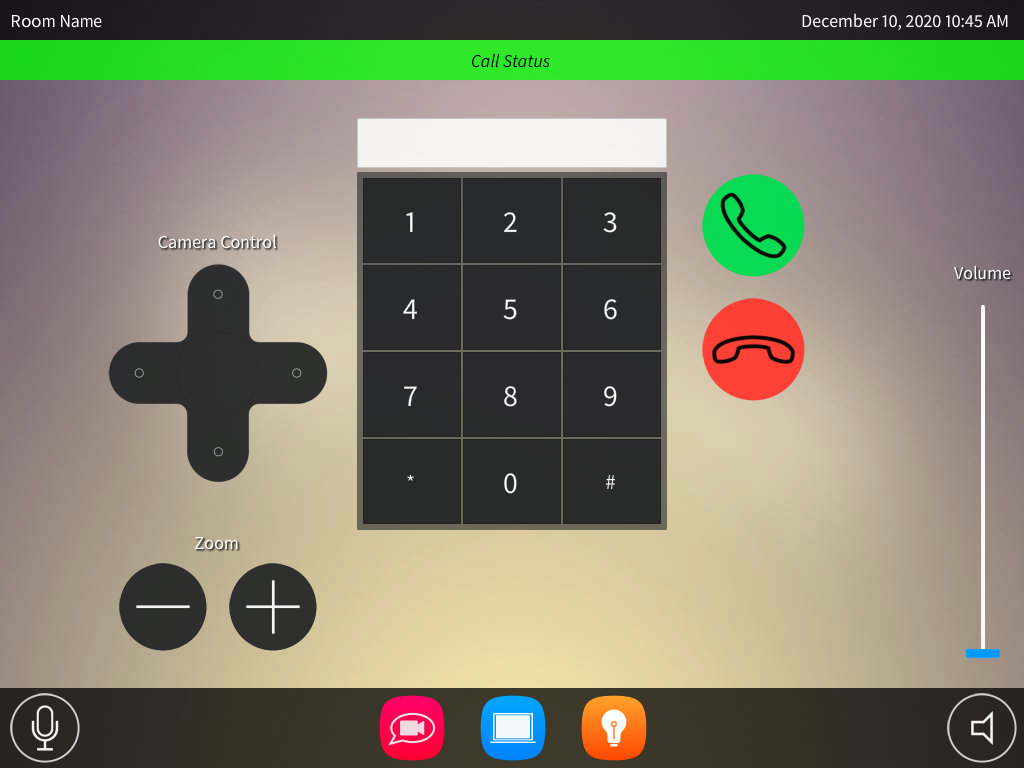
In this part, we’re going to explore how to interact with Smart Objects from SIMPL# Pro. You’ll need to have an XPanel layout to follow along. You can download my project from GitHub. It looks something like this:
Soup-to-Nuts: Phonebook Module (Part 4)
Here is the final part to this module: wrapping it up and making it easy to use. SIMPL Windows is a powerful tool because it easily abstracts away a lot of details about how things happen. The way our phonebook works under the hood will be a detail we needn’t worry about, it will just plug into our larger programs.
Continue reading “Soup-to-Nuts: Phonebook Module (Part 4)”Soup-to-Nuts: Phonebook Module (Part 3)
In this part, we’ll add support for pages to our phonebook. That may not sound like much, but it will set us up for the 4th (and final) part where we wrap everything into a SIMPL User Macro that we can easily drop into our programs.
Continue reading “Soup-to-Nuts: Phonebook Module (Part 3)”Soup-to-Nuts: Phonebook Module (Part 2)
In this part, we’ll continue to develop our Phonebook class to provide more functionality to our SIMPL Windows programs. We won’t quite finish in this part, but we’ll be very close.
Make sure you download the current source code from GitHub, too.
Continue reading “Soup-to-Nuts: Phonebook Module (Part 2)” Kiel the Coder